
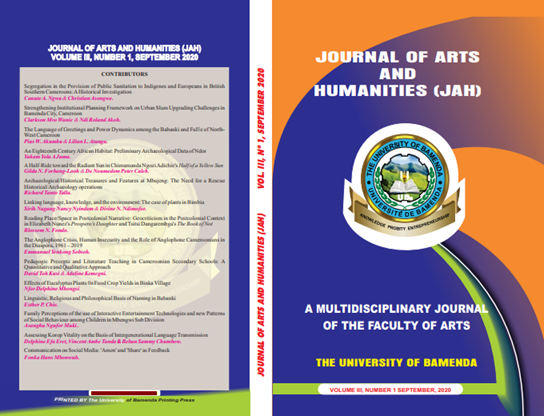
Strengthening Institutional Planning Framework on Urban Slum Upgrading Challenges in Bamenda City, Cameroon
Keywords:
Urban slums, upgrading, challenges, Institutional framework, Bamenda, CameroonAbstract
While slum upgrading depends significantly on a realistic institutional framework which provides functional and operational modalities, the pitfalls on urban planning for decent affordable housing conditions remain a nightmare in most African metropolis. It is against this backdrop that this study examinesthe constraints on slum upgrading challenges in Bamenda city. Field observation was carried out in the different slum development sites in Bamenda town to gather information on the state of slums vis-à-vis institutional actions in planning and development. Formal interviews were granted to personnel of
the Ministries of Urban Development and Housing, Decentralisation and Local Development as well as the City Councils. These interviews were complemented with published materials and Council Annual Reports on planning efficiency, challenges and development implications. Findings reveal
that slum upgrading is bedeviled by a plethora of challenges being the internal institutional conflicts, nepotism, embezzlement, bribery and corruption characterized by planning chasing development not development chasing planning and the lack of adequate, qualified and experienced manpower for planning and governance. Institutional capacity building as well as strengthening and adjusting urban planning frameworks is highly recommended for effective slum upgrading in the city.
Published
27-11-2020
How to Cite
Wanie, C. M. ., & Akoh, N. R. (2020). Strengthening Institutional Planning Framework on Urban Slum Upgrading Challenges in Bamenda City, Cameroon. JOURNAL OF ARTS AND HUMANITIES, 3(1), 23–40. Retrieved from https://www.fauba.scientific-board.com/index.php/jah/article/view/4
Issue
Section
Articles
Copyright & Licensing
All articles published in the Journal of Arts and Humanities are fully open access: immediately freely available to read, download and share. Articles are published under the terms of a Creative Commons Attribution-NonCommercial-ShareAlike 4.0 International (CC BY-NC-SA 4.0) Creative Commons license which permits use, distribution and reproduction in any medium, provided the original work is properly cited.